
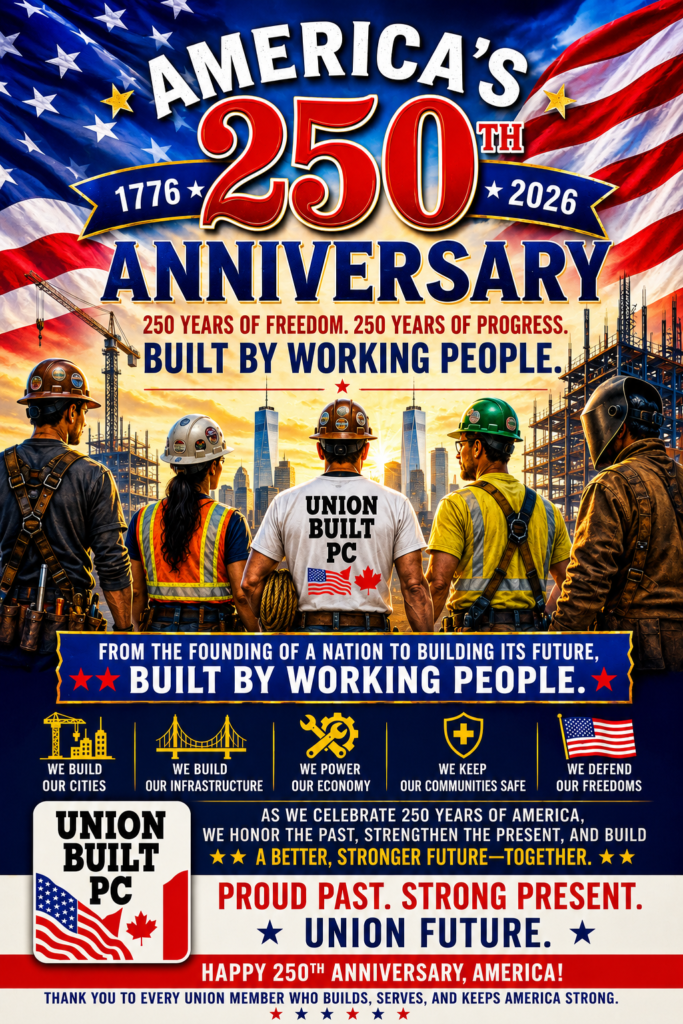
A Message to Every Union Member as America Turns 250
Published in honor of the Semiquincentennial — July 4, 2026
Pete Marchese , Director of Operations - Union Built PC Inc.When the fireworks light up the sky this Fourth of July, when politicians
take to stages across the country to toast 250 years of American freedom,
remember this: the nation they’re celebrating was built by workers like you.
Not by the men who signed the Declaration of Independence alone. Not by
the bankers who financed the railroads or the industrialists who owned the
steel mills. America was built by the hands, the sweat, the sacrifice, and the
solidarity of working people — many of whom had no voice, no vote, and no
protection when they showed up to do the job.
This anniversary belongs to us.
From the Very Beginning:
The story of American labor doesn’t begin in 1776. It begins even earlier
— and it begins with resistance.
In 1619, the first labor strike on American soil was organized by Polish
workers and artisans in Jamestown. Before there was a United States, there were
workers demanding dignity. In 1770, five dock workers were killed by British
troops in what history books call the Boston Massacre. Working people weren’t
bystanders to the Revolution — they were the Revolution.
By 1786, just ten years after the Declaration was signed, Philadelphia
printers walked off the job in the first successful strike for increased wages
in the new republic. The ink on the Constitution was barely dry, and workers
were already fighting to make its promises real.
That is the labor movement’s founding story: not waiting for freedom to
be handed down, but organizing to claim it.
The America Unions Built:
Over the next two and a half centuries, union members didn’t just work in
America — they built it. And then they built something better.
The 40-hour workweek didn’t come from a boardroom. The weekend didn’t
come from a stockholder meeting. Overtime pay, the minimum wage, the end of
child labor, workplace safety protections, Social Security, Medicare — every
one of these was won by organized workers who refused to accept less.
Consider what the labor movement secured for every American, union and
non-union alike:
- The eight-hour day — fought for across decades,
from the National Labor Union’s founding in 1866 to the Fair Labor
Standards Act of 1938, workers refused to surrender their lives entirely
to their employers. - The right to organize — workers faced criminal
prosecution, private armies, National Guard troops, and mass firings. They
organized anyway. The Wagner Act of 1935 finally codified what workers had
already proven: collective bargaining is a cornerstone of democracy. - Civil rights at work — when A. Philip Randolph
organized the Brotherhood of Sleeping Car Porters in 1925, he didn’t just
build a union. He built a movement that would march on Washington and
demand that America live up to its founding promises. Labor and civil
rights have always been the same fight. - Safety on the job — from the ashes of the Triangle
Shirtwaist fire of 1911, where nearly 150 workers — most of them young
immigrant women — died because exit doors were locked, rose a demand for
accountability that eventually led to OSHA in 1970. - A voice in the political process — labor unions didn’t just
transform the workplace. They transformed American democracy, helping
elect presidents, pass landmark legislation, and push the country,
imperfectly and continuously, toward a more just society.
An Honest Accounting:
Any honest celebration of 250 years must also acknowledge that the labor movement’s history is not without its own failures. For too long, too many unions excluded Black workers, women, and immigrants from full membership and equal protection. The promises of solidarity were not always kept for all workers.
But it was also labor — Black laundresses striking in Atlanta in 1881, Lowell mill women organizing in the 1830s, immigrant steelworkers and farm workers who built their own movements when they were shut out of existing ones — who pushed the movement to live up to its highest ideals. The ongoing, unfinished work of making labor solidarity truly mean all workers is part of this history too, and it is work that continues today.
The Fight That Never Ends:
America’s 250th anniversary arrives at a moment when working people face
profound challenges. Union membership, which covered roughly one in three
workers at its peak, has declined sharply in the private sector. Real wages for
many workers have stagnated for decades. The right to organize — won through
sacrifice and enshrined in law — is contested in workplaces and courthouses
across the country every single day.
The celebrations this July will be genuine and deserved. Two hundred and
fifty years is extraordinary. But union members know better than anyone that a
nation’s greatness is not measured in fireworks or ceremonies. It is measured
in how working people live — in whether a full-time job still means a dignified
life, in whether a worker can speak up without fear, in whether the promise of
America extends to everyone who builds it.
This Is Our Anniversary:
So when you watch the parades and hear the speeches this Fourth of July,
hold your head high. The America being celebrated is, in no small measure, the
America that labor built.
The eight-hour day. The weekend. The living wage. The safe factory floor.
The pension. The right to bargain collectively. These are labor’s gifts to this
nation — gifts that were not given freely but were won through courage,
organizing, and an unbreakable belief that workers deserve better.
Two hundred and fifty years ago, a group of men declared that all people
are endowed with certain unalienable rights — among them, life, liberty, and
the pursuit of happiness.
For 250 years, working people and their unions have been making that
declaration mean something.
The work continues. Happy 250th, America. We built this.

