
The Perversion of Capitalism
When Profit Replaces Purpose
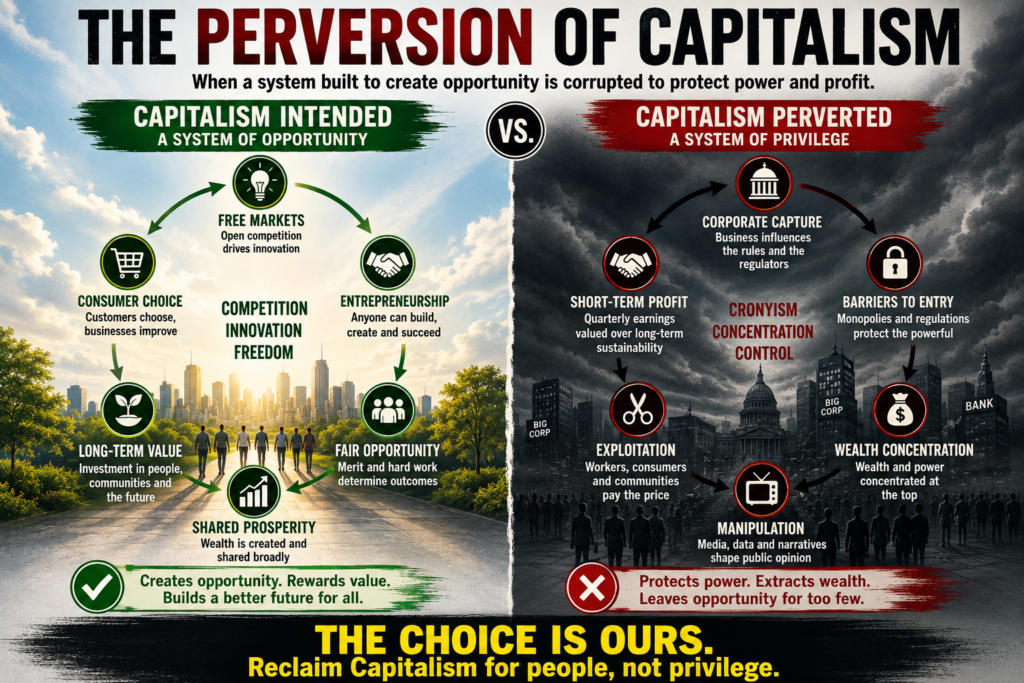
Capitalism has been one of the greatest engines of prosperity in human history. It has lifted billions out of poverty, driven technological innovation, rewarded entrepreneurship, and created opportunities unimaginable just a century ago. At its best, capitalism is a system built on competition, individual initiative, and the freedom to create value.
But somewhere along the way, something changed!
What many people experience today is not “the capitalism” envisioned by economists like Adam Smith, where free markets, fair competition, and consumer choice drive economic progress. Instead, we increasingly see a version of capitalism distorted by concentrated power, political influence, and the relentless pursuit of short-term profit. It is not capitalism that has failed, it is capitalism that has been perverted.
From Competition to Concentration
Healthy capitalism depends on competition. Businesses succeed by offering better products, better service, or lower prices than their competitors. Consumers benefit because companies must continuously innovate to earn their loyalty.
Today, however, entire industries are dominated by a handful of corporations. Whether in technology, finance, healthcare, media, or agriculture, market concentration has reduced competition and increased barriers to entry for smaller businesses. When companies become “too big to compete with,” innovation slows, prices rise, and consumer choice declines.
The entrepreneur with a brilliant idea often finds themselves competing not against another business, but against entrenched corporate power.
The Marriage of Business and Politics
Perhaps the greatest distortion of capitalism is the growing relationship between corporate interests and political influence.
Lobbying, regulatory capture, and preferential treatment allow powerful organizations to shape laws and regulations in ways that protect their market position rather than encourage competition. Government intervention increasingly benefits those with the greatest resources rather than those with the best ideas. When success depends more on political connections than on customer satisfaction, the free market ceases to be truly free.
Shareholders Over Stakeholders
For decades, many corporate leaders have embraced the doctrine that the sole purpose of business is to maximize shareholder value.
While profitability is essential for any successful enterprise, an obsession with quarterly earnings has encouraged decisions that prioritize immediate financial returns over long-term sustainability.
Employees become expenses rather than investments. Customers become data points rather than relationships. Communities become markets rather than partners. Innovation gives way to cost-cutting, stock buybacks, and financial engineering designed to inflate share prices rather than create lasting value.
The Cost to Union & Non Union Workers
Despite enormous increases in productivity, many workers feel they are falling behind. Housing costs have soared. Education has become increasingly expensive. Healthcare remains unaffordable for many families.
Meanwhile, executive compensation has grown dramatically, widening the gap between corporate leadership and the workforce that drives organizational success.
A thriving capitalist economy should reward hard work, encourage upward mobility, and create opportunities for the next generation. When those outcomes become increasingly difficult to achieve, confidence in the economic system begins to erode.
Labor Unions as Economic Partners
Today’s labor unions are not simply negotiating contracts. Many are investing in apprenticeship programs, workforce development, advanced technical training, safety education, and lifelong learning. Across construction, manufacturing, transportation, public service, healthcare, and the skilled trades, union training centers produce highly qualified professionals who strengthen industries and improve productivity.
A well-trained workforce benefits everyone:
- Workers gain valuable careers.
- Employers gain skilled employees.
- Communities gain economic stability.
- Consumers receive higher-quality products and services.
Technology: A New Kind of Monopoly
The digital age has created extraordinary opportunities—but also unprecedented concentrations of power.
A small number of technology companies now influence how we communicate, shop, work, consume information, and even participate in public debate. Data has become one of the world’s most valuable commodities, giving companies insights into consumer behaviour on a scale never before imagined.
Innovation should empower society. Instead, it risks becoming another mechanism through which dominant firms strengthen their market position and limit meaningful competition.
Restoring Capitalism
The answer is not to abandon capitalism. History has repeatedly demonstrated that centrally planned economies struggle to produce innovation, efficiency, and prosperity. Markets remain the most effective mechanism for allocating resources and encouraging entrepreneurship.
The challenge is restoring capitalism to its original principles.
That means:
Encouraging genuine competition.
- Preventing monopolistic behavior.
- Rewarding long-term investment over short-term speculation.
- Ensuring transparency in government and business.
- Supporting entrepreneurship and small business.
- Holding corporations accountable when they abuse market power.
Capitalism works best when success is earned—not protected.
A Better Future
The debate should not be between capitalism and socialism. It should be between competitive capitalism and crony capitalism. A healthy economy rewards creativity, risk-taking, innovation, and hard work. It creates opportunities for individuals regardless of background and allows businesses to thrive because they serve customers better—not because they possess greater political influence.
Capitalism has transformed the modern world. It has delivered unprecedented prosperity, medical breakthroughs, technological innovation, and rising living standards. Its future depends not on abandoning those principles, but on defending them. The question we must ask is not whether capitalism works. The question is whether we have allowed it to become something it was never meant to be.
If we are willing to restore competition, integrity, and accountability, capitalism can once again become a force not only for wealth creation, but for shared prosperity and human progress.

